If you, your husband, wife, son, daughter, friend or family member has just been arrested for drug trafficking in Malaysia, there is usually one question you want answered immediately: What happens next? The answer is easier to understand when a Section 39B drug trafficking case is broken into stages.A serious drug trafficking case in Malaysia normally does not begin with the High Court trial.It begins the moment the person is arrested. Our law firm Chambers of Sivahnanthan Ragava represents Malaysian and foreign nationals in serious drug cases throughout Malaysia, including clients and families from the United Kingdom, United States, Europe, Singapore, Australia and other countries. Overseas families seeking legal representation for a person arrested or charged in Malaysia may also refer to our guide on drug lawyer representation in Malaysia for foreign nationals worldwide.
From that point, the case may move through:
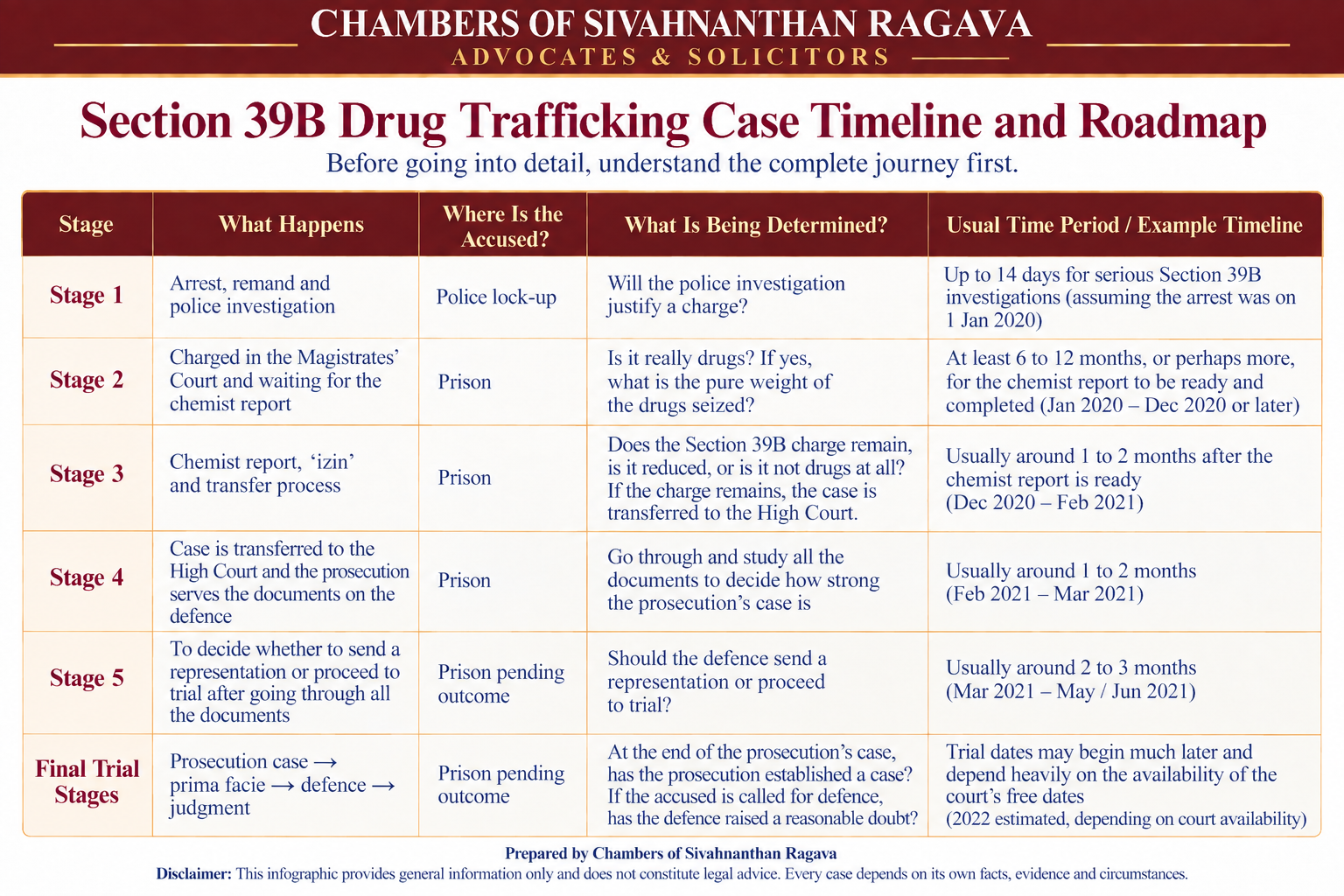
Arrest → Police Remand → Investigation → Charge in the Magistrates’ Court → Prison → Waiting for the Chemist Report → Public Prosecutor’s Consent (“Izin”) → Transfer to the High Court → Section 51A Prosecution Documents → Representation or Trial → Prosecution Case → Prima Facie Decision → Defence Case → Final Judgment→Appeal.
This page explains that entire journey from A to Z.
It is intended for Malaysian accused persons, foreign nationals and families searching for information about a drug trafficking case, drug arrest, Section 39B charge or serious drug offence in Malaysia.You may have reached this page by searching for a drug trafficking lawyer in Malaysia, drug case lawyer Malaysia, drug offence lawyer Malaysia, drug offense lawyer Malaysia, Section 39B lawyer Malaysia, drug lawyer Malaysia, drug trafficking case lawyer Malaysia, criminal lawyer in Malaysia or Malaysian criminal lawyer.Foreign families may use different terminology.A person in the United States may search for a drug attorney in Malaysia or drug case attorney Malaysia.A family in the United Kingdom may search for a drug offence solicitor in Malaysia.In Malaysia, the terms commonly used are lawyer, advocate and solicitor, criminal lawyer, drug case lawyer or drug trafficking lawyer.Whatever terminology brought you here, the important question remains the same:What exactly happens after somebody is arrested for a serious drug case in Malaysia?This guide explains it stage by stage.
Stage 1: You Have Been Arrested for a Drug Case in Malaysia – What Happens First?
First: Do not panic. Being arrested does not mean that the entire case has already been decided.It means the investigation has begun.The first hours after arrest can be extremely confusing.The accused may not know where he or she is being taken.The family may not know which police station is handling the case.Nobody may know exactly what quantity of drugs is involved.The family may start receiving advice from friends, agents, strangers or people claiming that they can “settle” the matter.This is when mistakes can begin.The accused should remain calm and understand that every stage that follows can affect the case later.For a more detailed immediate-action guide, read what to do immediately after being arrested for a drug case in Malaysia
Where Can a Drug Arrest Happen?
A drug case can begin in many different circumstances.
The alleged drugs may be found:
- on a person’s body;
- inside trousers or clothing;
- inside a handbag;
- inside a backpack;
- inside luggage;
- inside a car;
- beneath a vehicle seat;
- inside a vehicle boot;
- inside a hidden compartment;
- inside a house;
- inside a rented room;
- inside a condominium;
- inside a shared premises;
- inside a parcel;
- inside commercial goods;
- at a hotel;
- at a roadblock;
- at an airport;
- or at Kuala Lumpur International Airport (KLIA).
The place where the drugs are found is important because it may affect questions such as knowledge, possession, custody and control.Drugs found in a person’s pocket present a very different factual situation from drugs found in the boot of a vehicle used by several people.Drugs found in a private locked room may present different issues from drugs found in the living room of a house occupied by six people.Drugs found openly inside a suitcase may raise different questions from drugs concealed inside a specially constructed compartment.There is no single defence that applies to every drug case.
The facts determine the strategy.
What Happens Within 24 Hours of Arrest?
The police begin investigating immediately.If the police want to detain the accused for further investigation, the accused must be brought before a Magistrate for a remand application.For a serious Section 39B drug trafficking investigation, the police may seek up to seven days on the first remand application.At the end of that period, the police may apply again.A further period of up to seven days may be sought.This means that a serious drug trafficking investigation can involve a total remand period of up to 14 days, subject to the orders of the Magistrate.For less serious drug matters, the maximum remand period may be shorter (7 days).During this initial period, the accused is normally in the police lock-up.The accused has not yet entered the prison system as a person being held after charge.This distinction is important.Police lock-up and prison are two different stages of the case.
What Are the Police Doing During Those 14 Days?
This is not simply a period where the accused sits in custody while nothing happens.The police are building the Investigation Paper.Depending on the case, the Investigating Officer may be:
- recording the accused person’s statement;
- recording witness statements;
- weighing the suspected drugs;
- photographing the drugs;
- photographing the crime scene;
- marking exhibits;
- checking fingerprints;
- obtaining DNA samples;
- examining a vehicle;
- confirming ownership of a vehicle;
- confirming ownership or tenancy of premises;
- retrieving CCTV;
- examining telephone records;
- analysing WhatsApp or other messages;
- tracing possible accomplices;
- interviewing the raiding officers;
- sending the alleged drugs to the Chemistry Department;
- compiling search and seizure documents;
- and preparing the Investigation Paper for the prosecution.
For the detailed breakdown, read the 17 things police may do during a Section 39B drug trafficking investigation
This investigation stage matters because the evidence created and preserved here may later appear in the High Court trial.
Why the First Two Weeks Can Be So Important
Many families mistakenly believe that the lawyer only becomes important when the trial starts.That is not necessarily true.A serious criminal case may begin taking shape from the first day.Imagine that the accused says:“The bag was given to me by another person.”If that is genuinely the defence, the lawyer may need to know:
Who is that person?What is the person’s name?Where was the bag handed over?Were there witnesses?Was the meeting captured on CCTV?Are there WhatsApp messages?Who bought the bag?Who packed it?Who bought the airline ticket?Who paid for the hotel?Was money transferred?What did the accused believe was inside the bag?Can the person who supplied the bag be traced?Those questions are easier to investigate early than two years later.
A Serious Mistake: Waiting Until Trial to Build the Defence
Evidence does not remain forever.CCTV may be overwritten.Witnesses may disappear.Mobile phones may be reset or lost. People may forget exact details.Documents may become difficult to obtain.A defence that could have been supported by objective evidence in January may be much harder to prove by December.That is why defence preparation should not automatically wait for the trial date.A person facing a Section 39B charge should also understand the serious mistakes that can damage a drug trafficking case after arrest
Appointing a Criminal Lawyer During the Investigation Stage
During remand, the accused or family should consider appointing a criminal lawyer.The lawyer can attempt to obtain access to the accused.In practical terms, access during the earliest part of an active investigation may sometimes be difficult.Nevertheless, the lawyer can communicate with the Investigating Officer and seek permission to meet the client.The objective is not simply to tell the client:“Don’t worry.”
The lawyer needs instructions.A proper interview may include questions such as:
What happened before the arrest? Where did you go? Who were you with? Who owned the drugs? Where exactly were the drugs found? Did you know they were there? Who had access? Who owned the vehicle? Who had the keys? Who rented the room? Who packed the bag? What messages were exchanged? What did you tell the police? What documents did you sign? Were you threatened or pressured? Do you need medical attention?
The earlier this factual picture is understood, the earlier the defence can identify what may need investigation.
How Do You Know Whether the Person You Are Appointing Is Actually a Lawyer?
When families panic, they become vulnerable.Sometimes people receive calls from strangers.Sometimes someone claims to know the police.Sometimes someone says:
“You can only appoint this particular lawyer.”“This is the only lawyer approved for this case.”“You have no choice.”
Families should not blindly accept such statements.An accused person is entitled to choose legal representation. Recommendations are normal.Someone may recommend a lawyer because of experience or reputation.But a family should still conduct its own checks.Verify the lawyer.Verify the firm.Check professional credentials.At Chambers of Sivahnanthan Ragava, the firm’s registration documentation and the lawyer’s practising documentation are made available on the website for clients who wish to verify professional status.
For the full guide, read what you must know before appointing a criminal lawyer in Malaysia
Families dealing specifically with a serious trafficking allegation should also read the five critical steps to consider before choosing a drug trafficking lawyer
Can The Embassy, Police or Anybody Force a Foreign National to Use a Particular Lawyer ?
No ! For foreign nationals and their families, an Embassy’s list of lawyers or a recommendation from another person (friends or family) is just a general guidance, or guideline, but it should never replace your own independent research. Before appointing a lawyer, review the firm’s profile, conduct a Google search, and examine the lawyer’s experience in handling cases similar to yours. When someone’s liberty and future are at stake, choose your lawyer because you have carefully assessed their suitability not simply because someone recommended them.
No embassy, organisation, agency, or individual can force an accused person to appoint a particular lawyer. That is illegal. In Malaysia, a person has the legal right to choose a lawyer of his or her own choice. The decision as to who should provide legal representation belongs to the accused person and, where appropriate, the family acting on the accused person’s instructions.Therefore, if anyone tells you that it is mandatory to appoint only a particular lawyer from the Embassy, or anyone else, you may consider making formal complaint. No lawyer in Malaysia gains special powers or privileged access merely through a recommendation from the embassy, or any other person. Choose your lawyer based on relevant experience, competence, and commitment to your case not claims of influence.
Our professional advice and suggestion is simple: conduct your own independent research. Verify the lawyer’s credentials, examine the lawyer’s experience, speak to the lawyer directly, consider whether you are comfortable with the proposed representation, and then make your own independent decision.
The choice of lawyer should always be yours.
The fact that an accused person is from another country does not mean that the family loses the ability to select Malaysian legal representation.
Putting the Police on Notice of Defence Evidence
One important practical step during the early stage may be to formally notify the police about evidence favourable to the accused.Suppose the accused says:
“My phone contains messages proving that I believed I was carrying gold, not drugs.”“There is CCTV showing another person putting the bag into my car.”“The person who packed the luggage can be identified. in my phone”“There are messages showing that someone else had possession of the package.”
The lawyer may decide that the Investigating Officer should be put on notice of this evidence.
Why?
Because if the authorities are formally told that relevant evidence exists, but no proper investigation is carried out, that failure may become an issue later during trial.
The defence can potentially show the court:The police were informed.The evidence was identified.The request was made.But the investigation was not carried out.This is one reason why the work of a drug case lawyer can begin long before trial.
What Happens at the End of the Police Remand Period?
During the investigation, the police prepare the Investigation Paper, commonly called the IP. The Investigation Paper is referred to the Deputy Public Prosecutor.The prosecution then considers what should happen.Depending on the evidence, the accused may be released, investigated further or charged.If the prosecution decides to proceed with a Section 39B drug trafficking charge, the accused will be taken to court.
This begins the next major stage.
Stage 2: Charged With Drug Trafficking in the Magistrates’ Court
A common question from families is: “If Section 39B is such a serious offence, why is the accused brought to the Magistrates’ Court?” Because the Magistrates’ Court is the first court stage while the case is still waiting for important scientific and prosecutorial steps.The accused may be brought from the police station or lock-up and the charge will be explained. However, the Magistrates’ Court does not conduct the full Section 39B High Court trial. The case remains at the Magistrates’ Court stage while waiting for the chemist report and the later steps necessary for transfer.
For the complete explanation of this period, read what happens from the first day of a Section 39B charge until the chemist report is ready
What Happens to the Accused After Being Charged?
Once a person is charged under Section 39B and continued detention follows, the person will ordinarily no longer remain in the police lock-up.The person will be transferred into the prison system.From this point onwards, family members sometimes become confused because the accused is being taken between prison and court. Court appearances will be issued through an Order to Produce so that the accused is brought from prison when required.The lawyer may also need to visit the client in prison throughout the case.
Can You Get Bail for a Section 39B Drug Trafficking Charge?
This is one of the first questions almost every family asks.A Section 39B drug trafficking charge is treated as an unbailable offence.This means the accused will ordinarily remain in custody while the case is pending.This can be extremely difficult for families because the entire case may continue for years. The position is different for some less serious drug charges.
For the detailed explanation, read whether bail is available in a Section 39B drug trafficking case
What Other Drug Charges Exist Apart From Section 39B?
Not every drug case is trafficking.Malaysian drug offences include different categories depending on the substance, quantity and allegations.
These may include offences under provisions such as:
- Section 6;
- Section 12;
- Section 39A(1);
- Section 39A(2);
- and Section 39B.
The type and weight of the drug can significantly affect which provision applies.A person found with a small amount of cannabis, for example, is in a very different legal position from a person accused of trafficking many kilograms of cannabis. For a full breakdown, read the complete guide to drug offences in Malaysia and their punishments.
Stage 2 Is Mainly the Chemist Report Stage
After the person is charged, the case may remain in the Magistrates’ Court for months.Families often become frustrated.They attend one court date.Nothing appears to happen.Another date is fixed.They return.The prosecution says the chemist report is still not ready.Another date is fixed.This may continue again and again.That does not necessarily mean that something has gone wrong.The case is waiting for the scientific analysis.
What the Magistrates’ Court Timeline Can Look Like
Imagine the accused is arrested on 1 January.The police conduct the remand investigation.Suppose the accused is then charged around the middle of January.The next Magistrates’ Court date may be in February or March.At that mention, the Deputy Public Prosecutor may inform the court:“Chemist report is not ready.”The Magistrate fixes another mention.Perhaps May.In May, the report is still pending.Another date is fixed.Perhaps July or August.If the report is still not ready, another mention is fixed.Perhaps October or December.This process continues until the chemist report becomes available.The actual dates differ from case to case.The point is that a Section 39B prosecution can remain in the Magistrates’ Court for a considerable period before moving to the High Court.
How Long Does the Chemist Report Take?
There is no single guaranteed period.Based on the practical experience reflected in our drug case work, the waiting period may be many months and may sometimes approach or exceed a year.Some reports are completed earlier.Some take longer.The accused remains in custody during this stage where Section 39B continues to apply.This is one reason families should understand that serious drug litigation is not a short process.
Why Is the Chemist Report So Important?
The police may seize something they suspect is a dangerous drug.But suspicion is not the same thing as scientific confirmation.The Chemistry Department analyses the substance.
The report can establish:
- whether the substance is actually a dangerous drug;
- the type of drug;
- and the analysed weight.
These matters can affect the charge.The chemist report is therefore one of the most important documents in the entire case.
Can the Charge Change After the Chemist Report?
Yes.
Several possibilities can arise.
Possibility 1: The Substance Is Not Confirmed as the Alleged Drug
If the scientific analysis does not establish the substance as the alleged dangerous drug, the prosecution faces an obvious problem.
Possibility 2: The Weight Supports a Lesser Charge
The analysed result may lead the prosecution to consider a lesser provision.
Depending on the particular case, this could affect both the court and the bail position.
Possibility 3: Section 39B Remains
Where the drug and quantity continue to support the trafficking allegation, the Section 39B process continues.
Be Realistic About Very Large Quantities
Families sometimes hope that the chemist report will automatically reduce the case to something minor.That is not realistic in every case.For example, if the allegation involves an extremely large quantity such as 20 or 30 kilograms of suspected cannabis, one should not simply assume that laboratory analysis will reduce it to a tiny quantity below a serious threshold.Anything is theoretically dependent on the actual scientific finding, but strategy should be built on evidence rather than hope.The lawyer must wait for the result and assess it properly.
What Should the Drug Case Lawyer Be Doing While Waiting for the Chemist Report?
This is an extremely important part of the guide.Waiting for the chemist report does not mean the lawyer should do nothing for a year.This period can be used to build the case.
Depending on the facts, the work may include:
- interviewing the client in prison;
- obtaining the client’s full history;
- reconstructing the events before arrest;
- studying the arrest circumstances;
- identifying possible witnesses;
- conducting legal research;
- identifying available defences;
- reviewing telephone evidence;
- putting the Investigating Officer on notice of favourable evidence;
- applying for or seeking CCTV;
- identifying other people who had access;
- studying travel arrangements;
- examining vehicle ownership;
- examining tenancy or premises issues;
- considering private investigative assistance;
- dealing with the client’s welfare;
- monitoring the court proceedings;
- and preparing for the High Court stage.
A Section 39B lawyer should not first start learning the client’s story the week before trial.
Prison Visits Are Part of the Preparation
A client who remains in prison may need repeated consultations.
The lawyer needs to discuss:
- new information;
- documents;
- prosecution developments;
- representation strategy;
- possible witnesses;
- the defence story;
- trial preparation;
- and the client’s welfare.
In a case lasting two or three years, there may be many prison visits.Depending on the case, visits may occur monthly, every two months or whenever substantial work requires further instructions.For a broader explanation of this role, read what a criminal lawyer does from the moment of a Section 39B arrest until trial
Stage 3: The Chemist Report Is Ready – What Happens Next?
Suppose the chemist report is now completed.The next question is:Does the case remain under Section 39B? If the answer is yes, another important step follows. The prosecution must obtain the necessary consent to proceed. In practice, this is commonly referred to as “izin”.
What Is “Izin” in a Section 39B Case?
“Izin” means consent.
After the chemist report confirms the prosecution’s scientific position and the Section 39B charge remains, the prosecution obtains the necessary consent of the Public Prosecutor.There may therefore be another Magistrates’ Court mention while waiting for the consent documentation.Once the necessary consent is produced and the transfer process is completed, the Section 39B matter moves to the High Court.
How Long Between Chemist Report and High Court?
There is no exact period applicable to every case.Based on practical experience, there may be additional court dates while consent and transfer arrangements are completed.In some cases, the transition may occur over the following weeks or months.Once the Magistrates’ Court records the transfer, the High Court date must then be generated and the accused must be brought from prison.
Stage 4: The Case Reaches the High Court
This is a major change in the case.The matter is no longer simply waiting for the chemist report.The defence will eventually receive the prosecution material.The plea and case-management process takes place.The High Court becomes the court that will conduct the Section 39B trial if the charge is contested.For a detailed explanation, read what happens after a Section 39B case is transferred from the Magistrates’ Court to the High Court
The Most Important High Court Development: Section 51A Documents
Once the prosecution documents are served, the defence can finally see the prosecution case in much greater detail.These documents can fundamentally change the advice given to the accused.This is because before seeing the evidence, nobody should responsibly guarantee whether the case is “easy” or “impossible”.The documents tell the real story.
What Can Be Inside the Section 51A Prosecution Documents?
Depending on the case, the materials may include:
- police reports;
- statements;
- seizure documents;
- search lists;
- photographs;
- scene photographs;
- chemist reports;
- forensic reports;
- DNA reports;
- fingerprint reports;
- CCTV material;
- telephone evidence;
- documentary evidence;
- exhibit-handling documents;
- investigation material;
- and other evidence intended to be relied upon by the prosecution.
The quantity can be substantial.A serious drug trafficking prosecution may involve hundreds or even thousands of pages, photographs and digital materials.
This Is Where the Case Can “Make or Break”
The defence now begins comparing everything.The lawyer should not simply read each document in isolation.The question is whether the evidence fits together.For example:
Police Officer A says the drugs were found at 8:15 p.m.Police Officer B gives a different time.A photograph shows an object in one location.A police report describes another.An exhibit is recorded as one colour.Another document describes it differently.A bag is said to belong to the accused.The forensic report contains fingerprints belonging to somebody else.The prosecution says the accused exclusively controlled a room.The tenancy documents show several residents.The prosecution says the accused knew what was in a bag.WhatsApp messages may support a different explanation.The investigation says CCTV was checked.The actual CCTV may tell another story.This is why Section 51A disclosure is such a critical stage.
How Long Should It Take to Study the Prosecution Documents?
There is no fixed period.For a large Section 39B case, proper review can take weeks or months.
The lawyer may need to:
- read everything;
- classify the evidence;
- create timelines;
- compare statements;
- identify inconsistencies;
- examine the scientific evidence;
- identify missing evidence;
- speak to the client repeatedly;
- locate witnesses;
- conduct legal research;
- and develop the case theory.
Only after this can proper advice be given about the next strategic step.
After Section 51A: Three Main Routes
This is one of the most important parts of the entire case.Once the prosecution documents have been studied, the defence usually needs to consider one of three broad strategies.
Route 1 – Contest the Case and Go to Trial
If there is a proper defence and the accused maintains innocence, the case may proceed to trial, provided, the defence counsel has sent a representation to the Prosecutors first (Route 2) before opting for Route 1 which is a full trial.
Route 2 – Send a Representation Asking for the Entire Charge to Be Withdrawn
If the defence believes the prosecution should not proceed, a formal representation can be submitted seeking reconsideration and withdrawal.
Route 3 – Seek a Reduced Charge
Where the prosecution evidence is very strong and the accused wishes to resolve the matter, the defence may seek consideration of a lesser charge instead of proceeding on Section 39B.These routes are not automatically interchangeable.The appropriate strategy depends on the evidence and the client’s instructions.
Decision Tree After the Prosecution Evidence Is Received
A simple way to understand it is:
Section 51A documents (Prosecutions Documents) received
↓
Study the prosecution case
↓
Is there a strong factual and legal defence?
↓
YES → Consider representation for withdrawal
↓
If accepted → Case may end without full trial
↓
If rejected → Proceed to trial if client maintains innocence
OR
↓
Is the prosecution evidence extremely strong and the client wishes to resolve the case?
↓
Consider representation seeking a reduced charge
↓
If prosecution agrees → Plea may be entered to the amended charge
This is not an automatic formula.It is a strategic framework.Every file is different.
Route 1: When Should a Section 39B Case Go to Trial?
A lawyer may advise trial where there is a proper evidential basis to contest the prosecution.
Examples may include situations where:
- the accused denies knowledge;
- custody is disputed;
- control is disputed;
- several people had access;
- another person owned the vehicle;
- drugs were hidden;
- the accused was allegedly an innocent carrier;
- the phone evidence supports the defence;
- CCTV supports the accused;
- fingerprints point elsewhere;
- DNA suggests multiple occupants;
- prosecution witnesses contradict each other;
- the chain of evidence is questionable;
- important witnesses were not properly investigated;
- or there are serious procedural or evidential issues.
The lawyer must examine the evidence as a whole.One attractive fact does not automatically mean the case is strong.One bad fact does not automatically mean the case is hopeless.
What Must the Prosecution Establish in a Drug Trafficking Case?
The prosecution case may involve several essential areas.
These include:
- The substance is a dangerous drug.
- Possession of the drugs. Possession of the drugs is made up of Custody and Control, and Knowledge. Hence the prosecutions must prove that the accused has custody and control of the dangerous drugs first, and then they must also prove that the accused had knowledge of the drugs.
If one critical part of the prosecution case fails, that failure may affect the entire charge.
Knowledge: Did the Accused Know the Drugs Were There?
Knowledge is one of the most important issues in all drug cases. A person may physically carry a bag without necessarily admitting knowledge of everything hidden inside it. The court will therefore examine the circumstances. Relevant questions may include:
Who packed the bag? Was the bag locked? Did the accused know the password? How long did the accused possess it? Was the package sealed? Was anything hidden? What did the accused say before arrest? What messages were exchanged? Was the accused paid? What explanation was given for the journey? Did the accused behave suspiciously? What was found on the phone? What did other witnesses say? There is rarely one universal answer. Knowledge is proved or disputed through evidence.
Custody and Control: Who Actually Controlled the Drugs?
Custody and control becomes particularly important where drugs are discovered in a car, house, room or common area. Suppose the car belongs to the accused. That fact may be relevant.But it does not automatically answer every issue.Who else used the vehicle?Were there passengers?Was the car borrowed?Did somebody else have the keys?Where exactly were the drugs?Were they visible?Were they hidden?Was the accused even present when the drugs were discovered?The same applies to houses.Who stayed there?Was the room shared?Was the door locked?Did other people have keys?Were the drugs in a common area?Were there tenants? Were there visitors?
For the detailed guide, read how custody and control can be challenged in a Section 39B drug trafficking case
Break in the Chain of Evidence
Another important area is the chain of evidence. The prosecution is not simply required to say:“We found drugs.”
The prosecution must connect what was allegedly seized to what was analysed and ultimately produced in court.This can involve several stages:seizure;marking;handover;storage;movement;forensic examination;submission to the Chemistry Department;receipt by the chemist;analysis;and production in court.
The defence may study:
- dates;
- times;
- signatures;
- number of packets;
- colours;
- descriptions;
- markings;
- handover forms;
- storage records;
- chemistry receipts;
- and movements of exhibits.
A minor typographical error does not automatically destroy every case.But an unexplained material break in the identity or handling of exhibits can become important.For a detailed explanation, read how a break in the chain of evidence can affect a Section 39B case
Drug Mule Cases in Malaysia
Drug mule allegations deserve their own section because they commonly involve difficult questions of knowledge.A syndicate may use another person to transport a package or suitcase.Sometimes the courier knows exactly what is inside.Sometimes the courier may claim not to know.The phrase “drug mule” by itself proves nothing.The defence must look at the evidence.
KLIA Drug Trafficking Cases: Drugs Found Inside Luggage
A person may be stopped at Kuala Lumpur International Airport (KLIA) or KLIA 2.What happens here normally is – A bag is scanned.Something suspicious is detected.The luggage is opened.Drugs either found once the luggage is opened or A concealed compartment in the bag is found to have some dangerous drugs.The traveller is arrested.The immediate prosecution theory may be simple:The bag was with you.Therefore, you knew what was inside.The defence may be far more complicated.
Questions That Matter in an Airport Drug Mule Case
A proper investigation may ask:Who purchased the suitcase? Who packed it? Where was it packed? Was the accused present during packing? Was it already sealed? Who had the password? Was the accused told what was inside? Could the accused open the bag ? Did they accused know the contents of the bag ? Is there any reasons to be suspicious of the contents ? Did somebody ask the accused to carry it? Was the accused paid? Was the accused travelling for a legitimate purpose? Who bought the ticket? Who paid for accommodation? What do the WhatsApp messages show? Were there voice messages? What was said shortly before the flight? Was there CCTV where the bag was handed over? Were the drugs hidden inside a false compartment? Could an ordinary traveller reasonably have discovered that compartment? Were there fingerprints or DNA belonging to someone else? Who arranged the journey? Did the accused immediately identify the person who provided the luggage? Were those leads investigated? This is why drug mule cases can require substantial investigation beyond simply reading the charge sheet.
Example of an Innocent Carrier Defence
Consider this example.A traveller is told:“Take this suitcase to Malaysia. It contains gold.”The person agrees.The suitcase is supplied by another person.The traveller did not pack it.At KLIA, hidden drugs are discovered.The traveller says:“I genuinely believed I was transporting gold.”That claim alone is not enough.The lawyer must search for objective evidence supporting it.
For example:
Were there messages discussing gold? Did the accused ask questions about the gold? Did the accused know the suitcase password? Who provided the bag? Were there photos? Were there calls? Was payment discussed? Was the accused behaving consistently with the innocent explanation before arrest? Was there anything on the phone suggesting actual knowledge of drugs? The stronger the independent evidence supporting the accused’s story, the stronger the defence may become.
Foreign Nationals Charged With Drugs in Malaysia
Section 39B cases are not limited to Malaysians.
Foreign nationals may be arrested:
- at KLIA;
- at other airports;
- at hotels;
- in rented apartments;
- in vehicles;
- in transit;
- or after drugs are discovered inside luggage or parcels.
The family may be thousands of kilometres away.They may not understand Malaysian courts.They may not speak Bahasa Malaysia.They may not know the difference between police remand and prison.They may not know why no bail is available.They may not understand why the case is still in the Magistrates’ Court after many months. This guide is intended to answer those questions.
Can a Foreign National Appoint a Criminal Lawyer in Malaysia?
Yes.A foreign national facing a Malaysian criminal prosecution can appoint a Malaysian lawyer.The family can also communicate with the lawyer from overseas.Chambers of Sivahnanthan Ragava accepts instructions involving Malaysian and foreign clients subject to the circumstances of the individual case.
This can include families located in countries such as:
- Portugal;
- Greece;
- the United Kingdom;
- Singapore;
- China;
- India;
- Australia;
- New Zealand;
- Indonesia;
- Thailand;
- countries within Europe;
- countries within the Middle East;
- and other parts of the world.
The key issue is not nationality.The key issue is the Malaysian criminal charge and the evidence.
Why International Families Search Differently ?
British family may search: drug offence solicitor Malaysia,drug trafficking solicitor Malaysia,British citizen arrested in Malaysia,lawyer for UK national arrested in Malaysia. An American family from the United States of America may search: drug attorney Malaysia,drug trafficking attorney Malaysia,drug case attorney Kuala Lumpur,American arrested for drugs in MalaysiaA European family may search: foreign national arrested at KLIA,lawyer for drug mule Malaysia,drug trafficking lawyer for foreigner Malaysia. They are all essentially looking for the same thing:A Malaysian criminal lawyer who understands the local criminal process and can explain what happens next.
Route 2: Representation Asking the Prosecution to Withdraw the Entire Section 39B Charge
Once the Section 51A documents are studied, the defence may believe there are strong grounds for asking the prosecution to reconsider the case. A representation is a formal request. It may ask the prosecution to withdraw the charge entirely. This is different from going to trial. The purpose is to persuade the prosecution that the evidence or circumstances do not justify continuing the Section 39B prosecution.
What Can Be Put Into a Representation?
Every representation is different.
Depending on the case, it may rely on:
- lack of knowledge;
- lack of custody or control;
- another person’s involvement;
- favourable phone evidence;
- CCTV;
- witnesses;
- forensic evidence;
- investigative failures;
- absence of a nexus;
- medical evidence;
- documents;
- contradictions;
- weaknesses in prosecution evidence;
- and legal arguments.
The defence may also attach supporting documents.
A strong representation should not merely say:
“My client is innocent.”
It should explain why.
Can a Representation End the Case Without Trial?
Potentially, yes, if the prosecution accepts the representation and takes the appropriate step. But there is no guarantee.The prosecution can reject the representation. If that happens and the accused maintains innocence, the case may proceed to trial. A representation is therefore an opportunity to have the prosecution reconsider the case before the enormous time and expense of a full High Court trial.
Route 3: Seeking a Reduced Charge
Not every case is a strong trial case. Sometimes the Section 51A evidence may be extremely damaging.
Imagine the prosecution has:
- a video of the accused packing the drugs;
- photographs of the drugs being prepared;
- WhatsApp messages discussing the drug;
- communications saying that the package is ready;
- fingerprints;
- DNA;
- CCTV;
- and admissions.
A lawyer cannot responsibly ignore that evidence.The advice must be based on reality.When a Reduced-Charge Representation May Be Considered.Where the evidence is very strong and the accused gives instructions to resolve the matter, the lawyer may seek prosecutorial consideration of a lesser charge such as Section 39A(2), depending on the facts.This is different from asking for complete withdrawal.The defence is effectively saying: The client wishes to resolve the matter.Can the prosecution consider an amended charge carrying a lesser sentencing exposure than Section 39B? Whether the prosecution agrees is entirely a matter for the prosecution.
Why Not Plead Guilty to Section 39B Immediately?
Because the evidence should first be understood.
The defence may receive material showing that:
- the charge can be challenged;
- there is a basis for withdrawal;
- there is a basis to seek a lesser charge;
- or the accused’s initial understanding of the evidence was incomplete.
Once the prosecution documents are available, the lawyer can provide far more meaningful advice.
A serious decision should not be made blindly.
Sentencing After a Reduced Charge
The sentence depends on:
- the final charge;
- the facts;
- the quantity;
- previous convictions;
- plea;
- mitigation;
- medical circumstances;
- and the judge.
Based on our extensive courtroom experiences, some reduced Section 39A(2) cases resolved by plea may result in sentences within a range around seven to twelve years, although outcomes can be lower or higher depending on the case.This is not a guaranteed sentencing range. One matter handled involved an accused with cancer where a Section 39B allegation was ultimately reduced and significant medical mitigation was placed before the court.Each case turns on its own circumstances. Medical evidence can become relevant at different stages.
It may affect:
- prison welfare;
- applications for treatment;
- litigation strategy;
- representations;
- defence evidence;
- and mitigation.
If the accused has:
- cancer;
- psychiatric treatment history;
- serious chronic illness;
- major surgery;
- neurological conditions;
- or other significant medical issues,
the family should obtain proper records.Foreign medical records may also be relevant.The lawyer can then decide how and when they should be used.
Stage 5: The High Court Trial Begins
If the matter cannot be resolved by representation and the accused claims trial, the case proceeds to a full High Court hearing. The prosecution presents its case first. This is known as the prosecution stage.
Who May Give Evidence for the Prosecution?
The witnesses depend on the facts.
They may include:
- Raiding or arresting officer
- Supporting members of the raiding team
- Investigating Officer
- Government chemist
- Police photographer
- Exhibit or store officer
- Fingerprint expert
- DNA expert
- Owner of the premises
- Landlord
- Vehicle owner
- Condominium management representative
- CCTV witness
- Telephone or forensic witnesses
- Other witnesses connected to the investigation
A complex case may involve many witnesses.
Why the Investigating Officer Is So Important
The Investigating Officer often has to explain the overall investigation.The defence may question: What evidence was collected? What was not collected? Who was interviewed? Who was not interviewed? Was CCTV obtained?Were other suspects investigated?What happened to the phone?Were fingerprints taken?Was DNA analysed?How were exhibits stored?Were alternative explanations investigated?Why was a particular lead ignored?The investigation itself can therefore become part of the trial.
What Happens When a Prosecution Witness Comes to Court?
There are generally three stages.
Examination-in-Chief
The prosecution asks questions designed to present the witness’s evidence.
Cross-Examination
The lawyer for the accused questions the witness.This is where contradictions, investigation gaps and weaknesses can be tested.
Re-Examination
The prosecution may ask further questions to clarify matters arising from cross-examination.
For the full trial-stage guide, read what happens during the prosecution and prima facie stage of a Section 39B trial
What Happens After the Prosecution Calls All Its Witnesses?
The prosecution closes its case.The parties then address the High Court on whether a prima facie case has been established. This is one of the most important moments in the trial.
What Does “Prima Facie” Mean in a Section 39B Trial?
In practical terms, the High Court must decide whether the prosecution has established a sufficient case requiring the accused to answer.
There are two broad outcomes.
No Prima Facie Case
If the prosecution has failed at this stage, the accused can be acquitted without being required to present the defence case.
Prima Facie Case Established
If the High Court finds that the prosecution has established the required case at this stage, the accused is called to enter defence.
The case then moves to the defence stage.
Can a Section 39B Case Be Won Before the Defence Is Called?
Yes.An acquittal can occur at the end of the prosecution stage if the court finds no prima facie case. This is why cross-examination of the prosecution witnesses and analysis of the prosecution evidence are so important. The defence may never need to call a single witness if the prosecution itself has failed to establish the required case.
The Defence Stage
If the accused is called to enter defence, the defence begins presenting its case. The accused must receive detailed advice regarding the available options.These can include:
- giving evidence on oath;
- giving an unsworn statement where applicable;
- or remaining silent.
The strategic consequences are different.
Giving Evidence on Oath
In many factual defence cases, the accused may give evidence under oath. This allows the accused to explain:
- what happened;
- who owned the drugs;
- why the accused was present;
- how the bag came into the accused’s possession;
- what the accused believed;
- who had access;
- what happened before arrest;
- and why the prosecution’s theory is wrong.
The prosecution will then have the opportunity to cross-examine the accused.Preparation is therefore critical.
Giving Unsworn Testimony
This is when the accused can give evidence in court, but since it is unsworn, hence the prosecution cannot cross examine the accused.
When Might Remaining Silent Be Considered?
Remaining silent at the defence stage is a serious decision.It should not be taken merely because the accused is nervous about giving evidence.Based on the approach described in our practice material, such a strategy would generally only be considered in exceptional circumstances where counsel identifies a fundamental legal or procedural defect and concludes that the issue is sufficiently serious to be pursued as a legal point, potentially including on appeal.The risks must be carefully explained to the client.
Defence Witnesses
The accused may also call other witnesses.
These could include:
- family members;
- friends;
- employers;
- landlords;
- people who purchased tickets;
- people who witnessed the handing over of a bag;
- doctors;
- forensic witnesses;
- private investigators;
- or any person whose evidence is genuinely relevant.
The witness should have a purpose.
The defence does not become stronger simply by calling more people.
The question is whether the witness proves something important.
Example: Family Member Who Purchased the Flight Ticket
Imagine the prosecution suggests that the accused purchased a suspicious last-minute ticket as part of a trafficking plan.
But the accused says:
“My sister bought the ticket for me because I was travelling for a family reason.”
The sister may be able to produce:
- payment records;
- emails;
- booking confirmation;
- and evidence explaining why she purchased the ticket.
That can provide independent support for the accused’s version.
This is why defence witnesses matter.
Example: Doctor as a Defence Witness
Medical evidence may become relevant where the defence depends upon:
- psychiatric illness;
- mental health;
- cognitive impairment;
- medication;
- serious physical illness;
- or the accused person’s condition at the relevant time.
A doctor may therefore be required to explain records or an assessment.
The usefulness of such evidence depends entirely on the defence being advanced.
What Must the Defence Ultimately Achieve?
At the end of the trial, the High Court considers the evidence as a whole. The prosecution carries the burden imposed by criminal law. The defence seeks to demonstrate that the prosecution has not proved the charge to the required standard.
A reasonable doubt may arise from:
- the accused’s evidence;
- prosecution weaknesses;
- contradictions;
- alternative access;
- forensic evidence;
- missing evidence;
- chain-of-evidence issues;
- investigative failures;
- or a combination of many smaller problems.
Why Early Consistency Matters
Suppose a person tells the lawyer two years after arrest: “The bag belonged to John.” But during the first investigation, the accused never mentioned John. No message identifies John. No police report mentions John. No witness has ever seen John. The court may naturally ask why John only appeared much later. Compare that with a case where the accused identified John immediately, provided his telephone number and messages, asked police to investigate him and repeated the same account consistently. That is why early instructions can become very important.
What a Criminal Lawyer in Malaysia Should Be Doing Throughout the Case
The work can include:
During Arrest and Remand
- attend or advise on remand;
- challenge the nexus where appropriate;
- protect the client’s rights;
- seek access to the client;
- obtain early instructions;
- identify urgent evidence.
During the Magistrates’ Court Stage
- attend mentions;
- monitor the chemist report;
- visit the client in prison;
- continue investigation;
- communicate with the family;
- preserve evidence;
- conduct legal research.
After the Chemist Report
- analyse the result;
- consider whether the charge changes;
- monitor the consent and transfer process.
In the High Court
- obtain and analyse prosecution documents;
- advise on plea and strategy;
- prepare representations;
- conduct investigation;
- identify witnesses;
- prepare cross-examination;
- prepare trial.
During Trial
- cross-examine witnesses;
- challenge the prosecution evidence;
- make prima facie submissions;
- conduct the defence case if necessary;
- call defence witnesses;
- make final submissions.
This is why speaking to a criminal lawyer early after arrest can be important
Judgment: Acquitted or Convicted?
Once the Section 39B drug trafficking trial is completed and the defence case has come to an end, the High Court will ultimately have to make a decision: is the accused acquitted or convicted? At this final stage of the trial, the Judge must consider all the evidence presented by both the prosecution and the defence. In a criminal case in Malaysia, the prosecution carries the burden of proving the charge against the accused beyond reasonable doubt. The Judge will therefore consider whether, after hearing the entire case, the prosecution has successfully proved the charge beyond reasonable doubt, or whether the defence has raised a reasonable doubt in the prosecution’s case. This is the fundamental question at the end of a criminal trial. If the prosecution has failed to prove the charge beyond reasonable doubt, the accused must be acquitted.If the prosecution has proved the charge beyond reasonable doubt, the accused will be convicted.
What Happens If the Accused Is Acquitted?
If the accused is acquitted of the Section 39B drug trafficking charge, he or she will ordinarily be released from custody immediately, provided there is no other lawful reason for the person to remain detained.For someone who may have spent years in custody waiting for the chemist report, the High Court trial and the final judgment, an acquittal means that the prosecution has ultimately failed to prove the drug trafficking charge beyond reasonable doubt. The prosecution may, however, have a right to appeal against the acquittal.
What Happens If the Accused Is Convicted Under Section 39B?
If the accused is convicted of drug trafficking under Section 39B of the Dangerous Drugs Act 1952, the case will then proceed to the sentencing stage.The punishment presently provided under Section 39B(2) is:
Death Penalty ; OR
Life Imprisonment (30 years), together with whipping of not less than 12 strokes if the death sentence is not imposed.
Importantly, the death penalty for drug trafficking is no longer mandatory in Malaysia. The Court now has discretion when sentencing a person convicted under Section 39B.
What Is The Mitigation Factor After a Section 39B Conviction?
Before sentence is imposed, the defence lawyer will normally address the Court in mitigation. Mitigation simply means that the lawyer places before the Judge all relevant personal circumstances and other factors concerning the convicted person which the Court should consider before deciding the appropriate sentence. In a Section 39B drug trafficking case, mitigation can be extremely important because the Court is deciding between extremely serious sentencing consequences.Depending on the circumstances of the particular case, the defence may ask the Court to consider matters such as:
- the age of the accused;
- whether this is the accused’s first offence;
- whether the accused has any previous convictions;
- the accused’s medical condition or serious illnesses;
- whether the accused is the sole breadwinner of the family;
- the number and age of the accused’s children;
- whether the accused has elderly parents who depend upon him or her;
- whether any family member is sick or physically disabled and dependent upon the accused;
- the accused’s financial and family circumstances;
- the accused’s personal background; and
- any other exceptional or relevant circumstances particular to that individual.
There is no single standard mitigation that applies to every person.
For example, the mitigation presented for a 22-year-old first offender with elderly dependent parents may be completely different from the mitigation presented for a 60-year-old accused suffering from serious medical conditions.This is why mitigation should not merely consist of a few general sentences asking the Court for mercy. In a serious Section 39B drug trafficking case in Malaysia, the lawyer should place the convicted person’s circumstances before the Court properly and comprehensively.Ultimately, however, the sentence remains a decision for the Judge based on the law and the particular circumstances of the case.
The next question is equally important:
What happens if either side disagrees with the High Court’s decision?
That brings us to the next stage — the appeal to the Court of Appeal.
Appeal: What Happens After the High Court Decision?
If either the accused or the prosecution is dissatisfied with the decision of the High Court in a Section 39B drug trafficking case in Malaysia, the next stage may be an appeal to the Court of Appeal. For a Section 39B case that was originally tried in the High Court, the appellate process can potentially involve two further levels of court:
High Court → Court of Appeal → Federal Court
This means that the conclusion of the High Court trial does not necessarily mean that the entire criminal case has come to an end.
Who Can Appeal a Section 39B Decision?
An appeal can arise from either side. If the accused is convicted of drug trafficking under Section 39B, the accused may appeal against the conviction and, where applicable, the sentence.On the other hand, if the accused is acquitted, the prosecution may appeal against the acquittal.Therefore, an acquittal at the High Court is extremely important, but the prosecution may still exercise its right of appeal.
The 14-Day Notice of Appeal Is Extremely Important
One of the most important things to understand about a criminal appeal in Malaysia is the time limit. A Notice of Appeal must generally be filed within 14 days from the decision of the High Court.This deadline should be treated very seriously. A person should never assume that an appeal can simply be filed months later because he or she has changed their mind. There are legal mechanisms through which an extension of time may be sought in appropriate circumstances, but this should never be relied upon. An application made outside the prescribed period would require a special application to the Court to permit the matter to proceed, and the particular circumstances for the delay would have to be properly explained. Therefore, where an accused wishes to challenge a Section 39B conviction, the safest course is to ensure that the Notice of Appeal is filed within the prescribed 14-day period.
What Happens After the Notice of Appeal Is Filed?
Once the Notice of Appeal has been filed, the criminal appeal will be registered for purposes of the Court of Appeal proceedings and an appeal case number will be assigned.The appeal then begins to move through the appellate process.The High Court record becomes extremely important at this stage.
This will include documents such as the:
- Grounds of Judgment or Grounds of Decision;
- Notes of Evidence from the High Court trial;
- documentary exhibits and relevant court documents; and
- other parts of the record required for the appeal.
Unlike at the High Court trial, the appeal lawyer is no longer preparing to call all the prosecution and defence witnesses again. Instead, the lawyer must study what actually happened during the High Court trial. This would be the Grounds of Judgement by the High Court judge, if the High Court has erred in law or in facts.
The Petition of Appeal: Identifying What Went Wrong
After the relevant appeal papers are served, the appellant is required to file a Petition of Appeal within the prescribed period.The Petition of Appeal is an extremely important document because it identifies the specific grounds upon which the High Court’s decision is being challenged.In simple language, the lawyer must identify:
What did the High Court Judge get wrong?
The grounds may involve allegations that the learned High Court Judge:
- erred in law;
- erred in fact;
- erred in both law and fact;
- failed to properly appreciate important evidence;
- wrongly accepted or rejected particular evidence;
- failed to properly consider the defence;
- misdirected himself or herself on a legal principle;
- incorrectly applied the law to the evidence;
- failed to consider material contradictions or weaknesses in the prosecution’s case; or
- failed to properly apply binding legal authorities or precedents.
The exact grounds of appeal will depend entirely on what happened during the particular High Court trial. There is no standard Petition of Appeal that can simply be copied from one Section 39B case to another.
Is There Another Full Trial at the Court of Appeal?
No. An appeal is not normally a retrial of the entire Section 39B case.This is one of the most important things for an accused and his or her family to understand. At the High Court, the prosecution may have called investigating officers, chemists, arresting officers and numerous other witnesses. The defence may also have called the accused and other defence witnesses. Those witnesses DO NOT RETURN to the Court of Appeal simply to repeat their evidence all over again as their evidence has already been recorded in the Notes of Evidence.Instead, the Court of Appeal considers the existing trial record, including the evidence that was already given before the High Court, the High Court Judge’s Grounds of Judgment and the legal arguments advanced by both sides.Fresh evidence at the appellate stage is exceptional and subject to the applicable legal requirements.
What Happens During the Court of Appeal Hearing?
Before the appeal hearing, there will normally be case management and directions for the filing of the necessary documents and written submissions.Eventually, a hearing date will be fixed. The lawyers will then appear before the Court of Appeal in Putrajaya and make their arguments before the appellate court.The focus is very different from the High Court trial.The lawyer is not examining witnesses one by one. Instead, the lawyer will take the Court of Appeal through the Notes of Evidence, Grounds of Judgment, relevant exhibits, applicable legislation and previous court decisions to demonstrate why the High Court’s decision should or should not be disturbed.
For example, the defence may argue that:
The learned High Court Judge erred in law and/or in fact in finding that the prosecution had proved the charge beyond reasonable doubt.
The defence may then identify exactly where the alleged error occurred.
It may concern custody and control of the drugs, knowledge, possession, trafficking, statutory presumptions, credibility of witnesses, contradictions in the prosecution evidence, failure to properly appreciate the defence, or the application of previous court decisions.
This is why an appeal is fundamentally different from a trial.
At the appeal stage, the lawyer must identify the alleged errors in the High Court’s decision and persuade the appellate court that those errors justify appellate intervention.
How Long Does a Court of Appeal Case Take?
There is no fixed period within which every criminal appeal must be completed.
As a practical estimate, a Section 39B appeal may sometimes take around one year to one and a half years from the High Court judgment before reaching its substantive appeal hearing, although it may be shorter or substantially longer depending on factors such as:
- preparation of the Grounds of Judgment;
- completion of the Notes of Evidence and appeal record;
- filing of the Petition of Appeal;
- case management;
- filing of written submissions; and
- availability of hearing dates.
Therefore, families should understand that the appeal process itself may take considerable time.
What If the Court of Appeal Decision Is Also Unfavourable?
Where the Section 39B case originated as a trial in the High Court, the criminal appellate process does not necessarily end at the Court of Appeal. A further appeal may be brought to the Federal Court of Malaysia. The Federal Court is the highest court in Malaysia. Therefore, for a Section 39B drug trafficking case originally tried in the High Court, the progression may be:
High Court Trial
↓
Court of Appeal
↓
Federal Court
The appeal to the Federal Court involves another appellate process involving the court record, grounds of appeal, submissions and eventually the hearing of the appeal. Again, the witnesses are not ordinarily called back simply to conduct the entire criminal trial again. The focus remains on whether the decision of the court below should stand or whether there were errors of law, fact, or mixed law and fact which justify appellate intervention. A further appeal to the Federal Court can also take substantial time. Depending on the circumstances and the court timetable, the process may take another year or more, although every case is different.
Appeal Does Not Mean the Whole Trial Starts Again
The simplest way for a layperson to understand the Malaysian criminal appeal process is this:
A trial asks: “What actually happened, and has the prosecution proved the charge?”
An appeal asks: “Did the court below make an error which justifies interfering with its decision?”
At the High Court trial, witnesses testify, documents are produced, witnesses are cross-examined and the Court determines the facts.At the Court of Appeal and subsequently the Federal Court, the lawyers largely work from the existing trial record and explain why the decision below should either be upheld or overturned.In other words, an appeal is not simply a second chance to conduct the entire Section 39B drug trafficking trial again.It is a legal challenge to the decision already made.For an accused facing a conviction under Section 39B of the Dangerous Drugs Act 1952, this appellate process may represent the next crucial stage of the case after the High Court trial has ended.
Legal Fees for a Section 39B Drug Trafficking Case
Another question families naturally ask is:How much does a drug trafficking lawyer in Malaysia cost? There is no universal fee.
Every case is different.A matter involving one accused and limited documents may require less work than a case involving:
- several accused persons;
- hundreds of exhibits;
- many kilograms of drugs;
- complicated phone forensics;
- international witnesses;
- CCTV;
- extensive scientific evidence;
- numerous trial dates;
- and multiple prison visits.
For full Section 39B representation, our professional fees commonly fall within a substantial range of approximately RM90,000 to RM150,000 depending on the case.
The actual quotation depends on the circumstances.
Why Can Section 39B Legal Fees Be High?
Because the lawyer may be responsible for the case for several years.
The work can include:
- remand;
- police-stage intervention;
- numerous Magistrates’ Court mentions;
- High Court mentions;
- prison visits;
- correspondence;
- research;
- representations;
- document analysis;
- independent investigation;
- witness interviews;
- preparation of written submissions;
- cross-examination;
- full trial;
- and defence preparation.
The fee is therefore not simply for “going to court once”. It is payment for the complete professional work required within the agreed scope of representation.At Chambers of Sivahnanthan Ragava, the agreed professional scope and fees are recorded in writing so the client and family understand the arrangement.
Criminal Lawyer in Malaysia for Drug Cases Nationwide
Chambers of Sivahnanthan Ragava is based in Kuala Lumpur.However, serious criminal work is not restricted to Kuala Lumpur.Instructions can be accepted for appropriate criminal cases throughout Malaysia.This includes accused persons and families looking for:drug trafficking lawyer Malaysia;drug case lawyer Malaysia;drug offence lawyer Malaysia;drug offense lawyer Malaysia;Section 39B lawyer Malaysia;drug lawyer Malaysia;drug attorney Malaysia;drug case attorney Malaysia;drug trafficking case lawyer Malaysia;criminal lawyer in Malaysia;or Malaysian criminal lawyer.The firm can consider representation across Malaysian jurisdictions depending on the individual matter.
About Sivahnanthan Ragava
Only after understanding the entire case process should a client consider who will actually conduct the case.Sivahnanthan Ragava is a Malaysian criminal lawyer and founder of Chambers of Sivahnanthan Ragava.His practice focuses on criminal litigation.This includes serious drug cases, Section 39B drug trafficking matters, drug possession cases, remand proceedings, High Court trials and criminal appeals.His work has included serious drug prosecutions involving:
- substantial quantities;
- custody and control disputes;
- knowledge;
- chain of evidence;
- forensic evidence;
- and allegations carrying extremely severe consequences.
Cases handled have also appeared in Malaysian mainstream media.
Previous Drug Trafficking Acquittals By Sivahnanthan Ragava
Previous matters handled by Sivahnanthan Ragava have included reported acquittals in serious drug cases.
Examples referred to in the firm’s supporting material include:
- A moral studies teacher acquitted of drug trafficking;
- A college student acquitted of a drug trafficking charge;
- A couple acquitted in a case carrying extremely serious consequences;
- A store manager acquitted in a large cannabis trafficking prosecution;
- Iranian acquitted of drug trafficking.
- Singer Acquitted of drug trafficking
Previous results demonstrate experience.They do not guarantee the outcome of a future case.Every new case must be won or lost on its own evidence.